

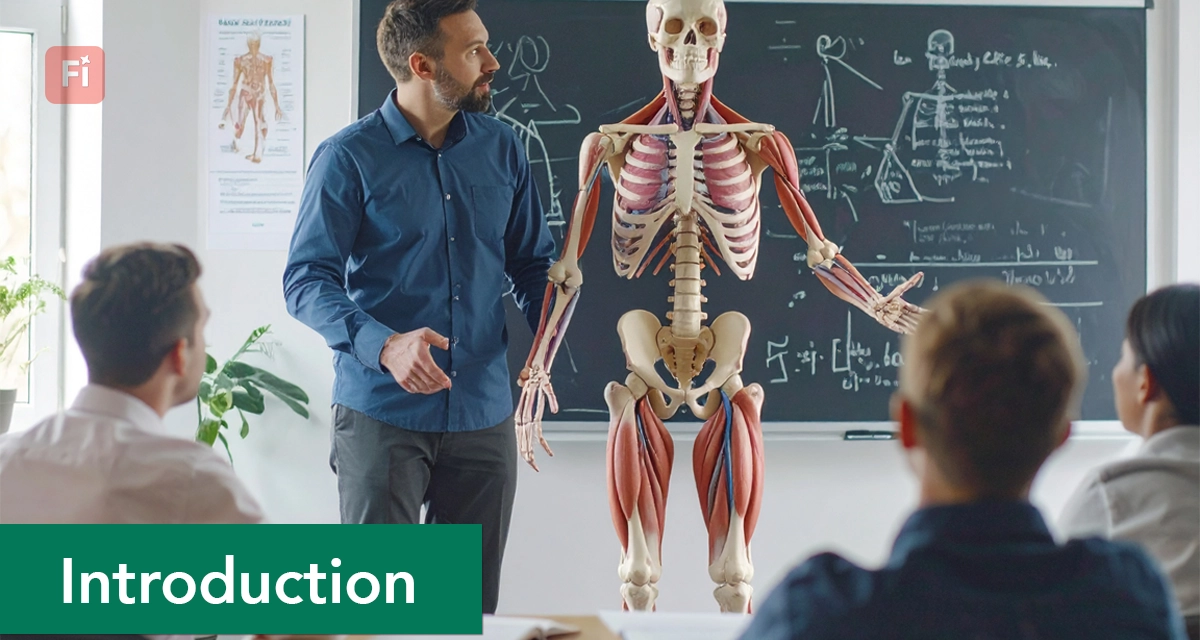
I use the motions that hurt and the give-and-take between skin, muscles, and joints to resolve musculoskeletal pain complaints. For me to do a good job, I have to know which skin, muscles, and joints relate to which motion and to each other.
You’re not going to like me for saying this, but you are not helping your clients the best you can. You can do so much better. That being said, it’s not your fault. You were taught wrong. All of us were. We were not handed the right tools. Take me, for example.
Like every other massage and soft-tissue therapist, I was taught traditional dissection anatomy. Everything cut up. All parts laid out, examined, and described. The integumentary, muscular, skeletal, nervous, circulatory, and lymphatic systems and their individually named parts like muscles, deep fasciae, bones, joint capsules, ligaments, and peripheral nerves, grouped by upper extremity, lower extremity, and torso. Good times! I learned a lot. Unfortunately, as I quickly found, my anatomical knowledge was difficult to put to use.
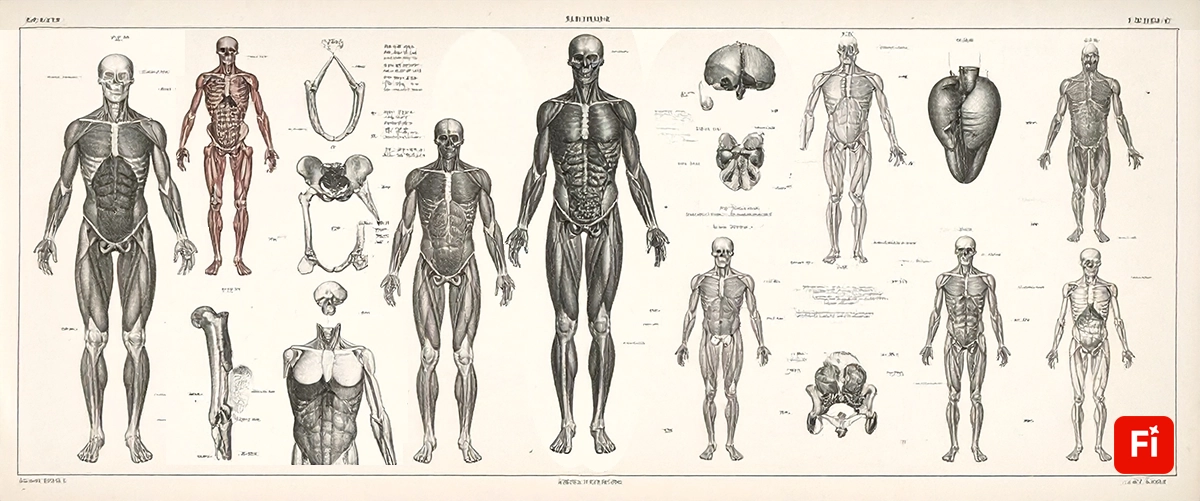
Traditional human anatomy according to AI.
You see, I approach the body as a whole. I do not consider single joints or muscles. The word “holistic” comes up often. I tell my clients that everything connects and promote an all-encompassing treatment approach. I mention the continuous “chatter” between organ systems and their parts. How skin, muscles, and joints interconnect, employ, and change each other. And how, because of that, the knee affects the hip and, in turn, the ankle affects the knee.
More practically, I use the motions that hurt and the give-and-take between skin, muscles, and joints to resolve musculoskeletal pain complaints. For me to do a good job, I have to know which skin, muscles, and joints relate to which motion and to each other.
Without a “translation,” traditional anatomy does not tell me what I need to know. And to be honest, why would it? It is its own science. It was not developed with soft tissue therapy in mind. It does not illustrate the influence between systems and their parts, or how all of them relate to motion. It has a different purpose altogether. It studies the structure of the human body.
I mean, take the word “anatomy.” It comes from the Greek “ana-tomia,” which loosely translates to “cutting up.” This makes sense when you consider Henry Gray, the renowned anatomist. His Gray’s Anatomy is a meticulous description of a dissection: limb by limb, piece by piece, layer by layer. By dividing the human body into smaller parts and studying their structural and topographical traits, it tries to make sense of something large and very complex, which it does.
Traditional anatomy, however, is not meant for massage and soft-tissue therapists like you and me. It does not paint a practical or holistic picture. It does not help us get a jumpstart on resolving musculoskeletal pain. For us to help our clients the best we can, we need a practical kind of anatomy.









⭐️⭐️⭐️⭐️⭐️