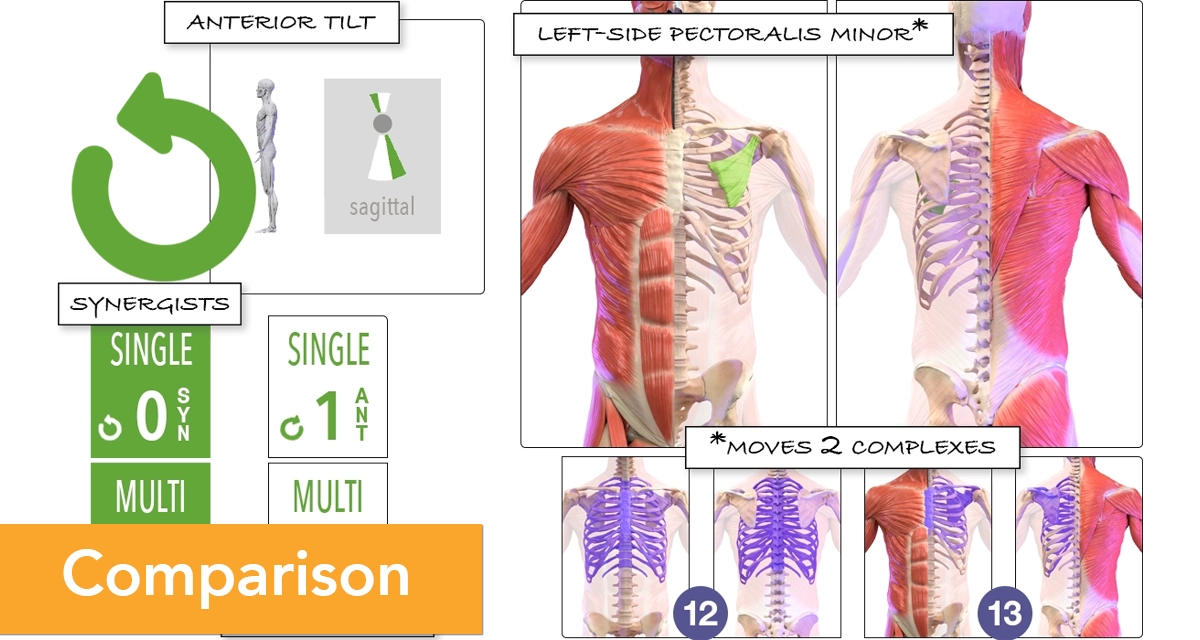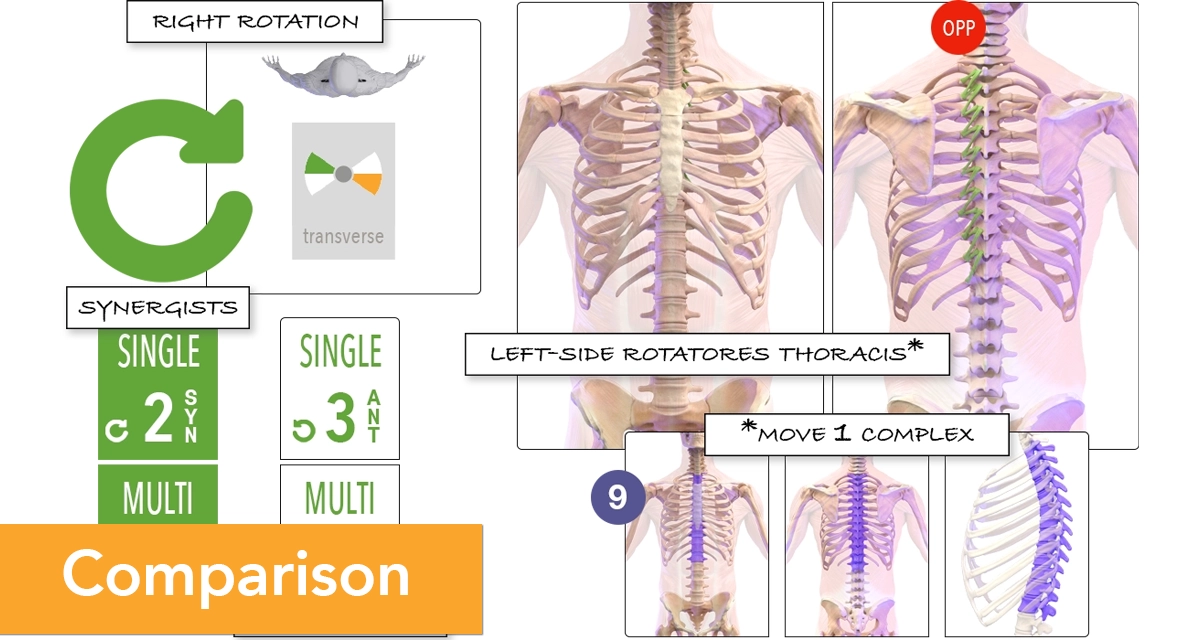


Before diving in deeper, I need to explain the planes in the anatomical planes of motion. They’re, after all, an essential part of this atlas. Planes are, of course, not the kind of planes you fly in. Instead, a plane is a mathematical idea. A plane is defined as “A flat, two-dimensional surface that extends infinitely, with no thickness.” You can think of it as a huge, but crazy thin sheet of glass.

The anatomical planes of motion. The orange circles represent a small part of the sagittal, frontal, and transverse planes, respectively. The arrows represent the motions per plane; flexion-extension, abduction-adduction, and lateral-medial rotation.
The anatomical planes of motion are three of these sheets, positioned perpendicular to each other. Applied to the body, the planes divide it into parts, equal or unequal. The first plane is called the sagittal plane; it divides the body left to right or width-wise. The second is called the frontal plane; it divides the body front to back or depth-wise. And the third is called the transverse plane; this plane divides the body top to bottom or length-wise. Each plane has an axis that runs perpendicular to the plane it belongs to. The axes are known as the frontal, sagittal, and vertical axes, respectively.
Around each axis, within each plane, there are two motions possible, one clockwise and one counterclockwise.