
Anatomy by Planes

Complex Joints Motions
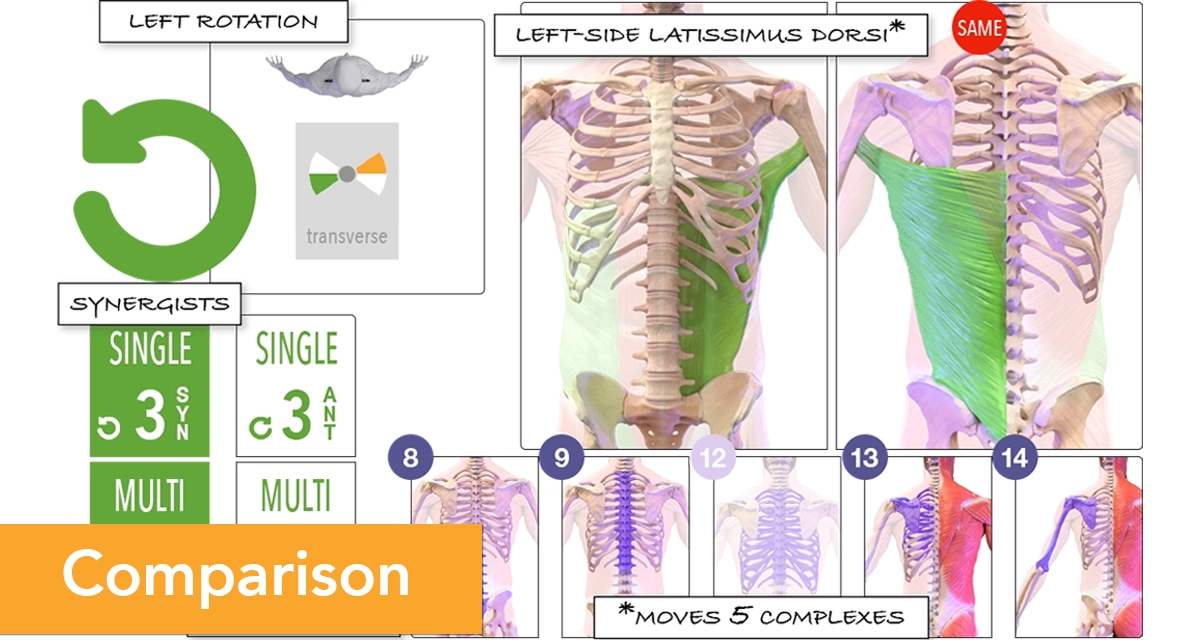
Transverse plane.
Transverse thoracic, T9.
Facet joints T1 - L1.
Intervertebral symphyses T1 - L1.
35 degrees left rotation.
35 degrees right rotation.
Indirect Motion Reciprocal Relationships ¶: left and right sides
C6 - L1.
Transverse rib cage, T12.
Transverse shoulder girdle, T13. 
Transverse rib cage, T12.
Transverse cervical, T10.
Transverse thoracis, T9. ←
Transverse lumbar, T8.

Muscles Single-Complex Depth of Muscle L: left side of the body
Right rotation (contralateral).
Rotatores Thoracis (longi and brevis). L
Thoracic. ←
Level 4 (deep to skin and three layers of muscle).
Single-Complex Antagonists (3) Multi-Complex Synergists (6) Multi-Complex Antagonists (6)
Multifidus (thoracic part, left-side).
Semispinalis thoracis (left-side).
Multifidus (thoracic part, right-side).
Rotatores thoracis (right-side).
Semispinalis thoracis (right-side).
External oblique (left-side).
Iliocostalis lumborum (lumbar & thoracic parts, right-side).
Internal oblique (right-side).
Latissimus dorsi (right-side).
Rectus abdominis (left-side).
Transverse abdominis (upper part, right-side).
External oblique (right-side).
Iliocostalis lumborum (lumbar & thoracic parts, left-side).
Internal oblique (left-side).
Latissimus dorsi (left-side).
Rectus abdominis (right-side).
Transverse abdominis (upper part, left-side).
Traditional Anatomy
Inferior attachment
From the twelfth to the second thoracic vertebrae, the individual muscles connect with the upper, posterior surface ot the vertebral transverse processes.
Superior attachment
From the eleventh to the first thoracic vertebrae, the individual muscles connect with the lower margin and lateral aspect of the vertebral lamina, positioned between the spinous processes medially and the transverse processes laterally.
Location
On each side of the body, the rotatores thoracis muscle is comprised of eleven pairs (longi and brevis), small, square muscles.
Because of how they generate motion, the individual rectangular muscles are assumed to run up and inwards. The longer heads (longi) run from one vertebra to the next, skipping one vertebra. The shorter heads (breves) cross from one vertebra to the one above it. The muscles run obliquely, from their transverse attachment inward to the vertebral lamina.
Innervation
By medial branches of the dorsal rami of spinal nerves.
Vascular Supply
Via dorsal branches of the posterior intercostal and lumbar arteries.
Motion
Extension (bilateral activity).
Rotation to opposite side (unilateral activity).