

The anatomical planes of motion are, by default, applied to the human body in a standard anatomical position. It is the body upright, facing forward, feet shoulder-width apart, arms at the side of the body with the palms turned forward. All of the illustrations in this atlas show the body in this position.
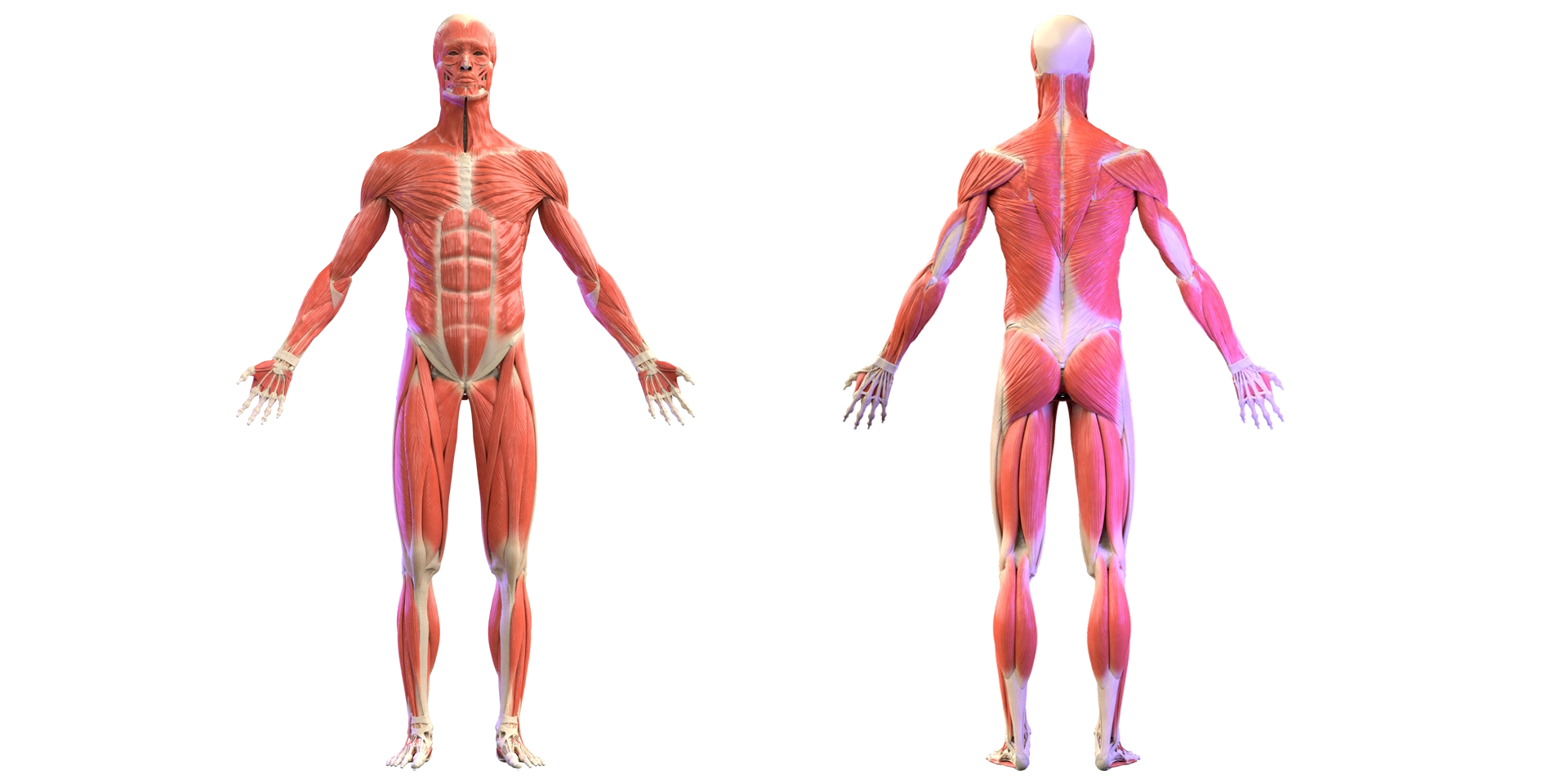
The standard anatomical position.
The standard position is, of course, nothing like real life. We lie down, sit, stand, and move about freely, whichever way our body allows. We do not limit ourselves to one position.
Variable as we may use our bodies, the planes and their axes are a constant. They are in relation to each other and to how they divvy up the body. Standing or supine (lying on one’s back), in a standard anatomical position, the sagittal plane always splits the body left to right, the frontal plane always divides it front to back, and the transverse plane always top to bottom.
We move in relation to the planes, not the other way around. This means that, for some joints, motion can change from one plane to another.

For some joints, motion can change from one plane to another.
This happens, for example, with rotation of the shoulder. In the standard anatomical position, shoulder rotation occurs in a transverse plane. But when you abandon the standard position by abducting your arm 90°, like throwing overhead, shoulder rotation moves. Changing from the standard anatomical to an overhead throwing position moves rotation of the shoulder from a transverse to a sagittal plane.
It’s easiest to keep track of through the axes. Axes are always situated perpendicular to their planes. During an overhead throwing motion, the rotational axis of the shoulder runs left-to-right, length-wise through the humerus. The plane located perpendicular to a left-to-right axis is the sagittal plane. So, rotation of the shoulder during an overhead throwing motion happens in the sagittal plane.